
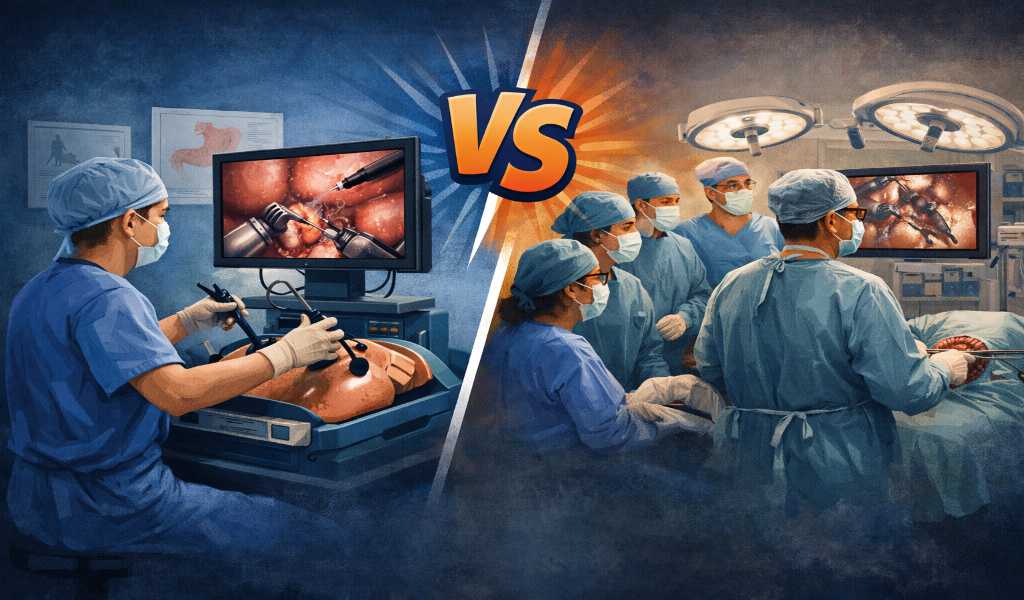
Is Hands-On Laparoscopy Simulation Better Than Observership Programs?
For decades, surgical training followed a simple model: observe, assist, and eventually perform. Observership programs became a key stepping stone for young surgeons to understand operating room dynamics and clinical decision-making.
But today, with rapid advancements in medical education, a new question is being asked more often:
Is watching surgery enough to become a skilled surgeon?
With the rise of hands-on laparoscopic simulation training, the focus is shifting from passive learning to active skill-building and the difference is significant.
What is an Observership Program?
Observership programs allow surgeons to:
- 1. Watch live surgeries
- 2. Understand procedural flow
- 3. Learn clinical judgment and decision-making
- 4. Gain exposure to real-world hospital settings
They are extremely valuable for:
- 1. Building foundational understanding
- 2. Learning surgical approaches
- 3. Observing expert techniques
However, most observerships come with a limitation:
Minimal or no hands-on experience
This means that while knowledge improves, technical skill development may remain limited.
What is Hands-On Laparoscopy Simulation Training?
A hands-on surgical simulation course is designed to help surgeons practice, not just observe.
These programs typically include:
- 1. Laparoscopic box trainers and virtual simulators
- 2. Step-by-step skill modules (camera handling, suturing, dissection)
- 3. Repetitive, structured practice
- 4. Real-time feedback and performance evaluation
Unlike observerships, simulation training focuses on:
Learning by doing” in a risk-free environment
Simulation vs Observership: What Does the Evidence Say?
Modern surgical education is increasingly backed by strong clinical research and the data clearly favors simulation when it comes to skill development.
1. Better Surgical Performance
Studies show that surgeons trained through simulation:
- Perform procedures faster
- Reduced operative time
- Increased confidence among trainees
2. Faster Learning Curve
A large meta-analysis of randomized trials found:
- Significant improvement in technical skills
- Reduced operative time
- Increased confidence among trainees
This is especially important in laparoscopy, where hand-eye coordination and instrument handling are critical.
3. Improved Patient Safety
Simulation-trained surgeons have been shown to:
- Cause fewer complications
- Make fewer critical errors
- Increased confidence among trainees
This highlights a key advantage:
Skills are refined before entering the operating room
Why Simulation Courses for Surgeons Are Gaining Popularity
1. Repetition without risk
In a real operating room, opportunities to practice are limited. In simulation:
- You can repeat the same skill multiple times
- Learn from mistakes without consequences
2. Structured learning approach
A well-designed surgical skills training program ensures:
- Standardized modules
- Progressive difficulty levels
- Measurable outcomes
3. Immediate feedback and improvement
Simulation allows:
- Objective performance tracking
- Real-time correction
- Faster skill refinement
4. Confidence before real surgery
One of the biggest challenges for young surgeons is confidence. Hands-on simulation:
- Builds muscle memory
- Reduces hesitation
- Prepares surgeons mentally and technically
Where Observership Still Matters
Despite its limitations, observership plays an important role.
It helps surgeons:
- Understand real surgical decision-making
- Observe complication management
- Learn operating room communication and teamwork
In short:
- Observership builds perspective
- Simulation builds performance
The Ideal Approach: Not One or the Other
The most effective surgical training today combines both:
Step 1: Simulation Training
- Develop core laparoscopic skills
- Achieve technical proficiency
Step 2: Observership Exposure
- Understand real-case scenarios
- Learn clinical judgment
Step 3: Supervised Practice
- Apply skills safely in real procedures
This blended model is now considered the gold standard in modern surgical education.
How Global Surgical Institute is Bridging the Gap
At the Global Surgical Institute, the focus is on preparing surgeons for real-world performance not just theoretical understanding.
The institute’s approach to training is built on three pillars:
1. Hands-On First Learning
Structured hands-on surgical simulation courses designed to:
- Build essential laparoscopic skills
- Enable repetitive, guided practice
- Improve precision and efficiency
2. Advanced Simulation Infrastructure
Training is supported by:
- High-quality laparoscopic simulators
- Realistic training modules
- Skill-based progression systems
3. Outcome-Focused Training
Programs are designed to ensure:
- Measurable skill improvement
- Increased surgeon confidence
- Better readiness for the operating room
4. Bridging Simulation to Surgery
Beyond simulation, the institute emphasizes:
- Clinical application
- Mentorship
- Transition from lab to live surgery
This ensures that surgeons are not just trained but truly practice-ready.
Final Thoughts
The future of surgical education is clear:
- Passive observation alone is no longer enough
- Skill-based training is becoming essential
- Patient safety depends on better-prepared surgeons
Hands-on laparoscopic simulation is not just an alternative it is rapidly becoming a necessity.
But the real advantage comes when simulation is combined with clinical exposure, creating a well-rounded, confident, and competent surgeon.
Looking to Upgrade Your Surgical Skills?
If you're exploring simulation courses for surgeons or a structured surgical skills training program, choosing the right training environment makes all the difference.
The right program won’t just teach you what to do It will prepare you to do it with confidence and precision.
